Expert-led product carbon footprints you can defend
Our sustainability experts calculate your product footprints, show you where the emissions sit and get you ready for verification. Pricing scales from one product to thousands, so you can answer customer, retailer and tender requests across your whole range.
Book a demo
Clients hitting their climate goals with Zevero












Product carbon footprint insights for smarter sustainability
AI matches your activity data to the most accurate emission factors, and our in-house experts check every match and result before it reaches you. Each PCF follows the GHG Protocol Product Standard and ISO 14067, with a documented methodology you can share with customers, auditors and verifiers.

Identify hotspots in the product lifecycle
Pinpoint stages where emissions are highest—from raw materials to disposal—so you can focus reduction efforts where they have the greatest impact.


Optimise product design for sustainability
Use carbon data to refine material choices, improve packaging, and enhance production processes, lowering impact without sacrificing quality or performance.


Build trust with transparent PCF data
Share a clear, defensible footprint with customers, retailers and investors, backed by a documented methodology and audit-ready evidence.


Simplify reporting and regulatory compliance
Answer customer questionnaires, tenders and rules such as CBAM and Digital Product Passports with product-level data that stands up to review.

Sustainability is now a competitive advantage.
Companies that measure emissions at the product level don’t just comply — they outperform.
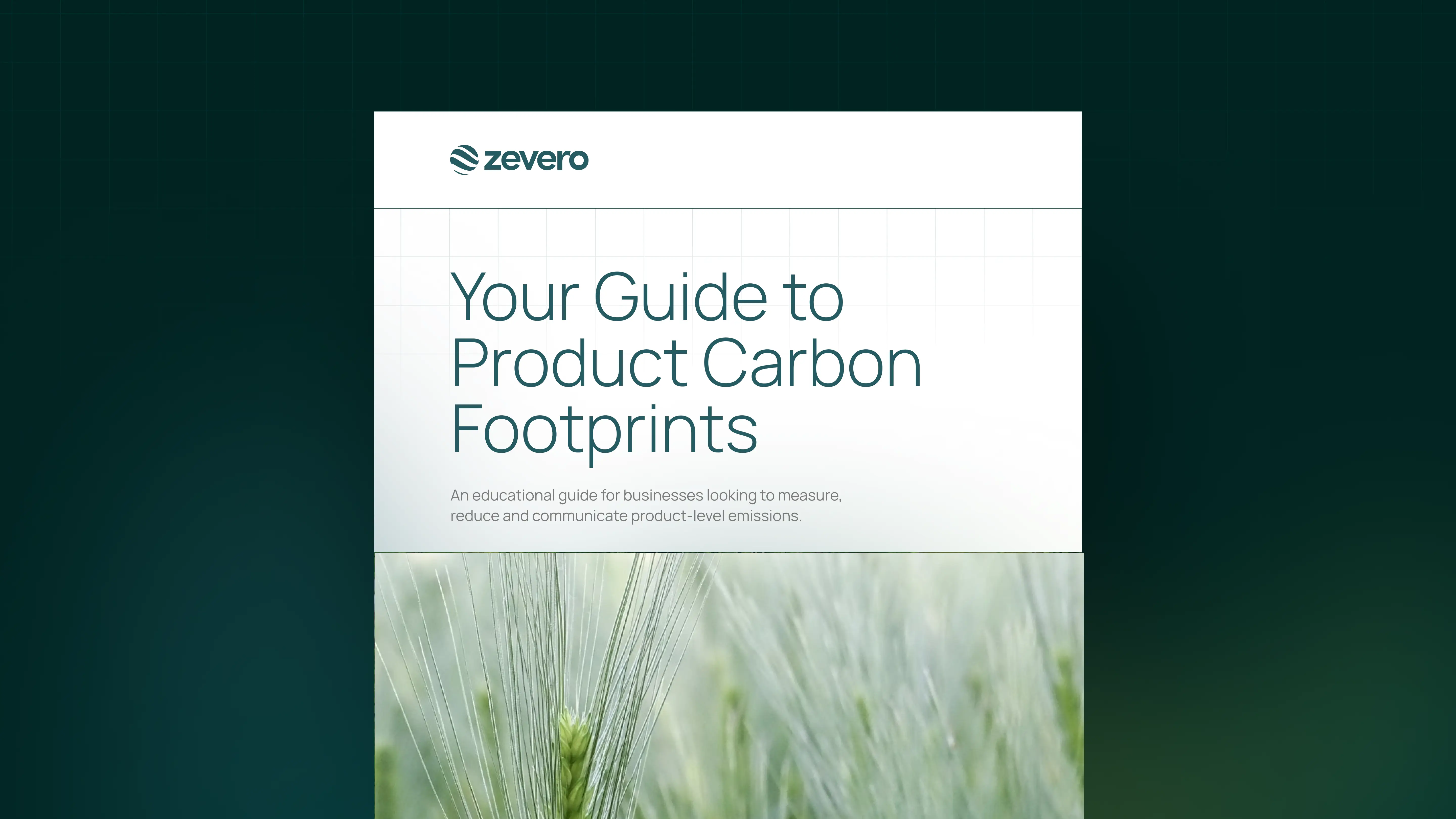
New to product carbon footprints? Read our guide to PCFs, LCAs and what customers expect.
What a product carbon footprint is, how it differs from an LCA or EPD, and how to get your first one done.
Or join the next live group demo →How waterdrop® reduced its impact with product carbon footprints
waterdrop® partnered with Zevero to conduct a product carbon footprint analysis for their Microdrink® COLA, helping measure emissions across the full lifecycle and make data-backed improvements.

Tracking product-level emissions
waterdrop® conducted a cradle-to-grave PCF assessment, measuring the total emissions per drink and per 12-pack.
Data-driven emissions reduction
Accurate measurement enabled waterdrop® to identify high-impact reduction opportunities and continue refining their sustainability strategy.
Building customer trust
By sharing verified emissions data, waterdrop® empowers consumers to make informed, sustainable purchasing decisions.
How product carbon footprints helped Delphis Eco scale sustainable innovation
Delphis Eco leveraged Zevero to measure and track the carbon footprint of products across its ingredient supply chain, integrating emissions data into its decarbonisation strategy.

Integrated, scalable carbon measurement
Delphis Eco embedded product carbon footprinting into its inventory system, making emissions tracking seamless across 1,000+ ingredients.
Targeted reduction strategies
With granular emissions insights, Delphis Eco built a data-backed decarbonisation plan, enabling more effective sustainability initiatives.
Strengthened market positioning
Clear sustainability data has helped Delphis Eco differentiate its products, reinforcing its position as a leader in premium, eco-friendly cleaning solutions.
How DEYA Brewing drives customer engagement with carbon labelling
DEYA partnered with Zevero to gain deeper insights into the carbon footprint of their beers, from raw ingredients to end-of-life, and share this data directly with consumers.

Measuring impact at every stage
By tracking emissions across six key lifecycle phases, DEYA gained granular visibility into ingredients, packaging, and transport.
Using insights to optimise production
By calculating carbon footprints per can, pint, and litre, DEYA identified key areas for reduction and process improvements.
Enhancing transparency with carbon labels
Displaying carbon footprint data on packaging and QR codes allows DEYA to educate customers and showcase its commitment to sustainability.
Discover our resources
View all


Your questions, answered
Learn more about product carbon footprints and how they can help your business.
A product carbon footprint measures the total greenhouse gas emissions a product generates from raw materials to disposal. It is expressed in kilograms of CO₂ equivalent (kgCO₂e).
Measuring product carbon footprints helps businesses comply with regulations, reduce emissions, and improve transparency with consumers and partners.
Our experts lead every PCF, with AI doing the heavy lifting. The steps are:
- Kick-off, scope and boundary: We agree the products and goals, then the boundary. Most customers choose cradle-to-gate, which covers raw materials up to the product leaving your site. We also do cradle-to-grave, which adds use and disposal.
- Data collection: You share your data using our templates. We use your suppliers' emission factors where you have them, and research or build tailored ones where you don't.
- Analysis and QA: AI matches your data to emission factors, and our experts check every match, run the calculations and carry out a sensitivity analysis.
- Report: You get a full methodology report, hotspot analysis and recommendations, plus a summary for your stakeholders.
Any business with a physical product can use a PCF. We do most of ours for food and drink brands, and also work with consumer goods, manufacturing and industrial goods, and construction and building materials companies.
Our pricing scales with the number of products. You can footprint one hero product or thousands of SKUs without the six-figure bill that consultancy-led projects often bring. Book a demo and we'll quote for your range.
We prepare your data, emission factors, documentation and methodology so you're ready for third-party verification against ISO 14067. The verification itself is done by an independent body.
A PCF looks at one impact, greenhouse gas emissions, across a product's life. A full LCA also covers other impacts such as water and land use.
Read our PCF vs LCA guide →If you’d like to learn more about how Zevero can support you with product carbon footprints, book a demo to discuss your options and see how we can help with your sustainability goals.
See the impact of product carbon footprints for your business
