
Policies & Frameworks

The new version of SBTi's FLAG Guidance is now in effect. Here's a breakdown of what changed, who's affected, and what action looks like in practice.
On 19 March 2026, the Science Based Targets initiative (SBTi) published Version 1.2 of its Forest, Land and Agriculture (FLAG) Science-Based Target-Setting Guidance. The update came into effect immediately. If your business has FLAG-related emissions and you're planning to submit or update science-based targets in 2026 or beyond, the new requirements apply to you now.
The revision came through an "urgent revision" provision, outside the regular update cycle, to address two criteria that required immediate attention: the company scope definition (FLAG-C1) and the no-deforestation commitment requirements (FLAG-C4). Both were approved by the SBTi Technical Council and adopted by the Board of Trustees following public consultation. This post covers what changed, who it affects, and what action looks like in practice.
A quick orientation: what FLAG is and why it matters
FLAG targets sit separately from a company's energy and industry science-based targets. They cover land-related emissions only, measured to the farm gate, across three categories: land use change (deforestation, peatland drainage, coastal wetland conversion), land management emissions (enteric fermentation, fertiliser use, flooded rice paddies), and land-based carbon removals (forest restoration, agroforestry, soil organic carbon).
The scale of the category makes it hard to deprioritise. FLAG emissions account for roughly 22% of net global greenhouse gas emissions, around 13 GtCO₂e per year, and land-sector action represents approximately 37% of the mitigation potential needed by 2030.
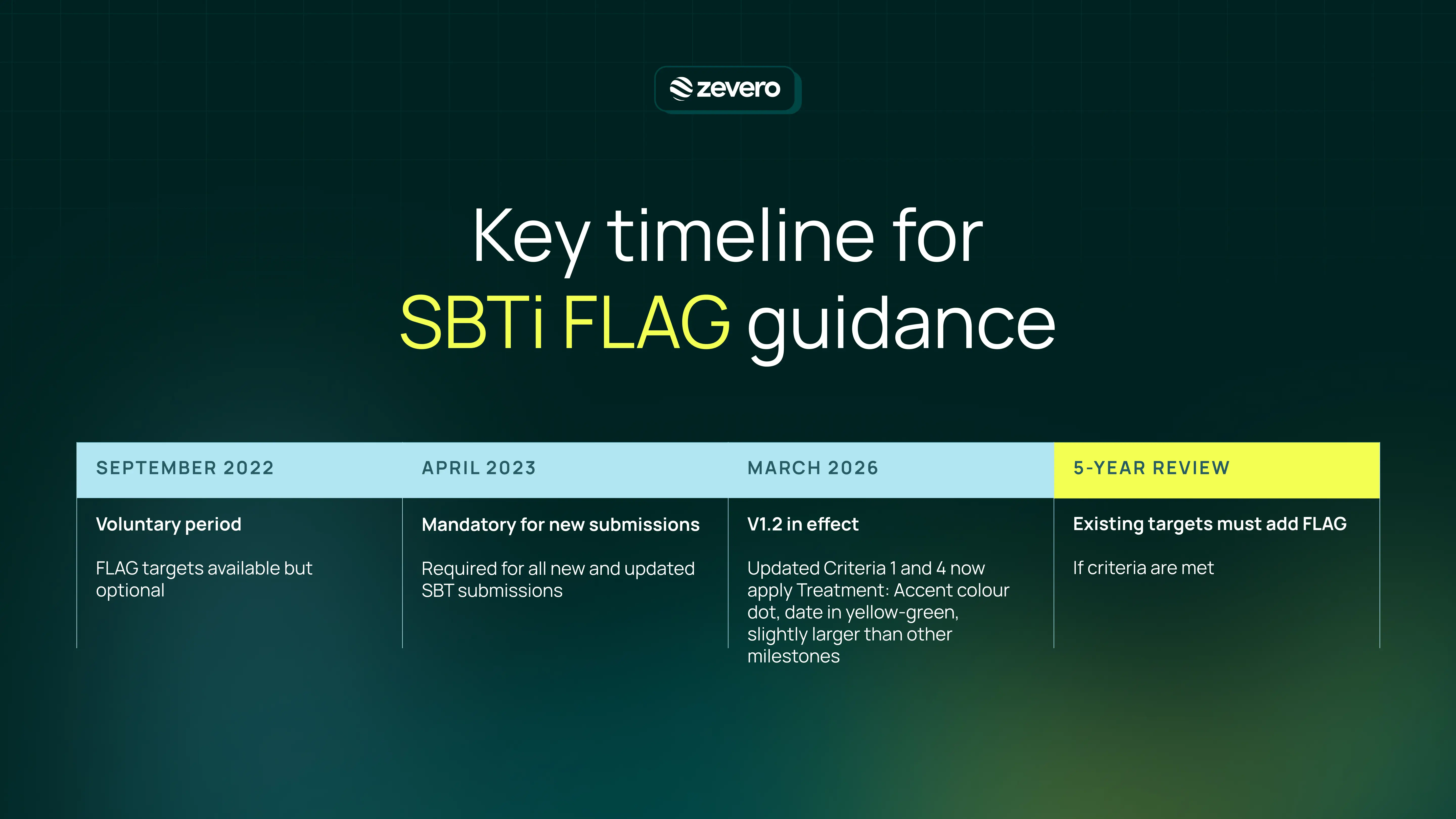
FLAG target setting was built into the SBTi framework in stages. The guidance launched in September 2022 as a voluntary option. From April 2023, it became mandatory for all new and updating SBT submissions that meet the FLAG criteria. Version 1.1 followed in December 2023 with minor updates. Version 1.2, published this month, is the first substantive revision.
What changed in version 1.2
Revised deadline for existing SBT holders
No changes were made to the definition of which companies are required to set FLAG targets. The two triggers remain: sector membership (Forest and Paper Products, Food Production, Food and Beverage Processing, Food and Staples Retailing, Tobacco), or FLAG-related gross emissions totalling 20% or more of total Scope 1, 2, and 3 emissions.
What v1.2 changes is the deadline for companies that already have validated science-based targets but have not yet set a FLAG target. Previously, these companies were required to add a FLAG target within six months of the GHG Protocol Land Sector and Removals Standard's publication. Under v1.2, that deadline has been removed. Companies in this position must now set a FLAG target at the latest as part of their mandatory five-year review submission, and should do so as soon as possible.
No-deforestation deadline
The 2025 no-deforestation deadline has been removed. Companies setting FLAG targets for the first time now have up to two years after submitting their targets for SBTi validation to achieve no-deforestation, with a hard cap of 31 December 2030 for submissions made after 2028. Companies with existing validated commitments dated 2025 may revise to no later than 31 December 2028. Any revision requires public disclosure of progress against the previous commitment, including barriers encountered. The SBTi's strong recommendation is to maintain existing commitments where possible. Companies whose targets were submitted in 2025 but not yet approved may voluntarily align with v1.2.
Expanded commodity requirements
The list of primary deforestation-linked commodities that must be assessed has expanded from five to seven, now aligning with the EU Deforestation Regulation. Coffee and rubber have been added alongside the existing five: cattle, cocoa, oil palm, soy, and timber. The assessment must cover all seven commodities, including where they appear as feed or transformed ingredients at or above 1% of a finished product.
Deforestation cutoff dates
The 2020 cutoff date is now a formal requirement, not just a recommendation. Where a 2020 cutoff is not achievable for specific portions of the value chain, the cutoff must be no later than three years prior to the company's first FLAG target submission. This must be disclosed and justified publicly, with 2020 or earlier cutoff dates maintained for all other portions. Cutoff dates cannot be moved to a later date once set.
New documentation requirement
Within 12 months of validating a FLAG target, companies must publish on their own website or in relevant policy documents:
- The method and outcome of their assessment of primary deforestation-linked commodities
- Key information on how they plan to deliver their no-deforestation commitment
The commitment itself must also be posted on the SBTi target dashboard using the required wording: "[Company X] commits to no-deforestation across its primary deforestation-linked commodities, with a target date of [no later than 2 years after FLAG target submission date, and no later than 31 December 2030]."
Alignment with the GHG Protocol Land Sector and Removals Standard
Version 1.2 updates references throughout the guidance to reflect the publication of the GHG Protocol Land Sector and Removals Standard, released in January 2026. These are largely editorial changes, replacing references to the 2022 draft with the final standard. Companies may continue to use the 2022 draft until 1 January 2027, when the new standard becomes mandatory for FLAG target submissions.
The framework you're working within
With the v1.2 changes in view, it helps to be clear on the full set of requirements you're navigating.
Who must set a FLAG target
Companies in FLAG-designated sectors, or any company where FLAG-related gross emissions represent 20% or more of total Scope 1, 2, and 3 emissions. SMEs are exempt. Companies with FLAG-related emissions below 5% of their overall footprint are also exempt, but must still include those emissions in their energy and industry targets and cannot include FLAG removals in that boundary.
There is an additional Scope 3 obligation worth flagging: companies that meet the FLAG criteria and whose Scope 3 gross emissions represent 40% or more of total Scope 1, 2, and 3 emissions must set both a FLAG Scope 3 target and a separate energy/industry Scope 3 target. Each 67% coverage threshold must be met independently.
Emissions coverage
The FLAG target must cover at least 95% of FLAG-related Scope 1 emissions and at least 67% of FLAG-related Scope 3 emissions. Removals must be reported separately from emissions and cannot be netted against each other within the target.
FLAG abatement cannot be used to meet energy and industry targets. Land management CO₂ removals may only count toward FLAG targets. This prevents companies from using land-sector improvements to offset fossil fuel reductions they should be making elsewhere.
The SBTi offers two approaches, which can be combined using the FLAG Aggregator Tool. The sector approach is an absolute reduction target requiring a 3.03% reduction per year, best suited to companies with diversified FLAG emissions. The commodity approach is an intensity reduction target covering 11 commodities (beef, chicken, dairy, leather, maize, palm oil, pork, rice, soy, wheat, and timber and wood fibre) across 26 regional pathways. It is applicable where a single commodity represents 10% or more of total FLAG emissions and required for timber and wood fibre sector companies.
Action checklist: six steps to set your FLAG target
- Determine whether you are in scope. Check FLAG-designated sector membership and whether FLAG-related gross emissions exceed 20% of total Scope 1, 2, and 3. Reassess against the updated v1.2 criteria if your previous assessment was borderline.
- Build your FLAG greenhouse gas inventory. Quantify land use change emissions (using dLUC or sLUC), land management emissions, and land-based removals, aligned with the GHG Protocol Land Sector and Removals Standard. Meet Scope 1 (95%) and Scope 3 (67%) coverage thresholds. Report removals separately from emissions.
- Choose your pathway. Select the sector approach, commodity approach, or a combination. Use sub-global pathways for commodities where available. Use the SBTi FLAG Aggregator Tool to bring approaches into a single target.
- Set your no-deforestation commitment. Assess primary commodities in your value chain. Confirm your cutoff date is no later than 2020 where possible. Set your target date within two years of submission. Post the required commitment language on the SBTi dashboard.
- Submit for SBTi validation. Submit base year emissions, activity data, Scope 1 and 3 coverage data, and separately reported removals. Within 12 months of validation, publish your commodity assessment methodology and no-deforestation delivery plan on your website.
- Report annually and review. Track progress against your FLAG target each year. Reassess at five years. Recalculate if triggered by significant operational changes such as mergers, acquisitions, or major shifts in land use.
How Zevero can help
If you're approaching a five-year SBT review, setting targets for the first time, or reassessing your FLAG position in light of the v1.2 update, we can help you get there with data that holds up to scrutiny. Talk to our sustainability team about your FLAG requirements.
FAQs
Does my company need to set a FLAG target?
We already have a validated FLAG target with a 2025 no-deforestation date. What do we need to do?
What's the difference between the sector approach and the commodity approach?
Thanks for reading!
SBTi FLAG Guidance v1.2: What Changed & What to Do Next
Add us as a preferred source

Related posts
Read more

Blog
Mar 2, 2026
Understanding the GHG Protocol Land Sector and Removals Standard
Understanding the GHG Protocol Land Sector and Removals Standard

Read more
Blog
May 8, 2024
How Regenerative Agriculture Helps Reduce Your Carbon Footprint
How Regenerative Agriculture Helps Reduce Your Carbon Footprint
See how Zevero can streamline your carbon reporting
Grow your business and reduce your impact
